


Section 179 vs Bonus Depreciation vs Luxury Auto Limits: Business Vehicle Deductions for Orange County Owners

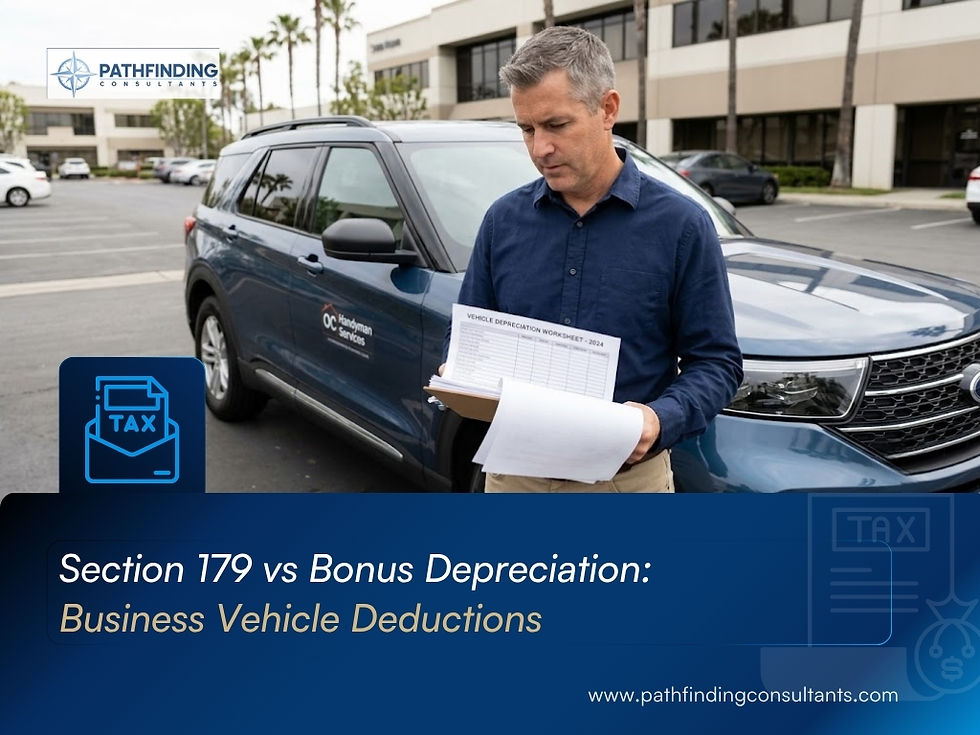
Two business owners can buy the exact same vehicle for the exact same price and end up with wildly different first-year tax deductions — and the difference has nothing to do with how the vehicle is used. It comes down to weight. A section 179 vehicle deduction depends heavily on the vehicle's gross vehicle weight rating, and getting this wrong before a purchase is one of the most expensive mistakes a business owner can make. Pathfinding Consultants provides business tax preparation Orange County business owners rely on to plan vehicle purchases around these rules before signing, not after.
IRS DISCLAIMER: This article is for general informational purposes only and is not tax, legal, or accounting advice. Vehicle depreciation rules depend on the specific vehicle's weight rating, business-use percentage, and current-year IRS inflation adjustments. Always consult a qualified tax professional, Enrolled Agent, or CPA before purchasing a business vehicle or relying on this guide for a specific filing decision. Pathfinding Consultants encourages every Orange County business owner to seek personalized guidance for their own business. |
The Weight Threshold That Changes Everything
A section 179 vehicle deduction is governed by an entirely different set of rules depending on whether a vehicle's gross vehicle weight rating (GVWR) falls above or below 6,000 pounds. Passenger cars and light trucks at or below 6,000 pounds GVWR fall under the luxury auto depreciation limits of Internal Revenue Code Section 280F, while heavier vehicles are governed by a separate, far more generous set of rules (source: IRC Section 280F; IRS Instructions for Form 4562). Business owners consistently underestimate how much a few hundred pounds of GVWR can change a gvwr tax deduction outcome: a vehicle rated at 5,950 pounds is capped by luxury auto rules, while a similar vehicle at 6,100 pounds is not — a gvwr tax deduction difference worth tens of thousands of dollars in the first year alone. A business consulting near me search before signing on a vehicle is, in practice, a gvwr tax deduction check most dealerships will never volunteer.
For tax years beginning in 2026, the section 179 vehicle deduction limit for a heavy SUV with a GVWR between 6,001 and 14,000 pounds is capped at $32,000, up from $31,300 in 2025 (source: IRC Section 179(b)(5)(A); IRS Rev. Proc. 2025-32). This heavy suv tax deduction cap exists specifically to prevent unlimited first-year expensing on large SUVs — a rule Congress added in 2004 to close what was informally called the "Hummer loophole."
Luxury Auto Depreciation Limits Under Section 280F
For passenger vehicles at or below 6,000 pounds GVWR, luxury auto depreciation limits cap the first-year deduction regardless of the vehicle's actual purchase price. For 2026, when bonus depreciation applies, luxury auto depreciation limits allow $20,300 in the first year, $19,800 in the second year, $11,900 in the third year, and $7,160 in each year after that (source: IRS Rev. Proc. 2026-15). If bonus depreciation is not claimed, the 2026 first-year luxury auto depreciation limits figure drops to $12,300, with the same amounts applying in later years.
These luxury auto depreciation limits mean a $60,000 sedan used 100% for business does not generate a $60,000 first-year deduction — it generates the capped amount under luxury auto depreciation limits, with the remaining basis recovered slowly over subsequent years. This is precisely why heavier vehicles are such a common planning target: luxury auto depreciation limits simply do not apply to a properly qualifying heavy vehicle.
Bonus Depreciation and Heavy Vehicles Together
Bonus depreciation business vehicle rules currently allow 100% first-year bonus depreciation for qualified property, including vehicles, acquired and placed in service after January 19, 2025 (source: IRC Section 168(k); IRS Rev. Proc. 2026-15). For a heavy vehicle exempt from luxury auto depreciation limits, a bonus depreciation business vehicle strategy typically works in two steps: apply the section 179 vehicle deduction up to the $32,000 heavy SUV cap first, then apply bonus depreciation business vehicle treatment to the remaining basis.

For example, a $90,000 heavy SUV used 100% for business could take a $32,000 section 179 vehicle deduction against the heavy suv tax deduction cap, then apply 100% bonus depreciation business vehicle treatment to the remaining $58,000 of basis — reaching close to full first-year expensing, something entirely unavailable to a vehicle subject to luxury auto depreciation limits.
Planning a business vehicle purchase before year-end?
Confirm the deduction before you sign.
(949) 620-1036 | https://www.pathfindingconsultants.com/
Section 280F Limits and the Business-Use Requirement
Every vehicle deduction strategy — section 179 vehicle deduction, bonus depreciation business vehicle treatment, or the section 280f limits themselves — depends on the vehicle being used more than 50% for business. Business vehicle depreciation orange county owners claim is proportionally reduced by any personal-use percentage, and falling below the 50% business-use threshold in a later year can trigger depreciation recapture on amounts already deducted (source: IRS Publication 946, How To Depreciate Property).
Certain vehicle types are exempt from both the heavy suv tax deduction cap and section 280f limits entirely: pickup trucks with a cargo bed of at least six feet, cargo vans with no rear passenger seating, and vehicles with a GVWR over 14,000 pounds generally fall outside these vehicle-specific caps and are instead subject to the broader Section 179 and bonus depreciation rules that apply to other business equipment.

Why Vehicle Purchases Need Tax Planning Before the Sale
Business vehicle depreciation orange county planning has to happen before a purchase, not after, because the GVWR sticker on the vehicle — not the sales brochure — determines which set of rules applies. Business owners searching for business consulting near me after purchasing a vehicle assuming full deductibility are often discovering, too late, that their chosen model fell just under the 6,001-pound heavy vehicle threshold and is instead subject to luxury auto depreciation limits.
Pathfinding Consultants is an Enrolled Agent firm providing business tax preparation Orange County business owners have relied on to confirm GVWR, business-use percentage, and section 280f limits before a vehicle purchase, not after the deduction is already locked in by the numbers on the title. An orange county business vehicle purchase should always start with a GVWR tax deduction review, not end with one — confirming the gvwr tax deduction category before signing is the single highest-leverage step in the entire process. Business tax preparation Orange County clients who bring us the window sticker before the purchase, not after, consistently walk away with a materially better orange county business vehicle outcome.
Common Mistakes With Business Vehicle Depreciation
Assuming a large vehicle automatically qualifies as a heavy vehicle without confirming the actual GVWR on the manufacturer's label
Applying the section 179 vehicle deduction to a passenger vehicle under 6,000 pounds GVWR, when luxury auto depreciation limits apply instead
Failing to combine the heavy suv tax deduction cap with bonus depreciation business vehicle treatment on the remaining basis
Not tracking business-use percentage carefully enough to avoid depreciation recapture if usage drops below 50% in a later year
Assuming section 280f limits are fixed figures rather than inflation-adjusted amounts that change from year to year under a new Revenue Procedure
Every one of these mistakes is avoidable with a review of the vehicle's actual GVWR and intended business use before the purchase is finalized, not after the deduction has already been locked in. A business consulting near me search before signing is how most business vehicle depreciation orange county clients end up with an orange county business vehicle purchase that maximizes the deduction instead of accidentally landing in luxury auto territory.
Get your business vehicle deduction strategy reviewed before you buy.
Pathfinding Consultants — Business Tax Preparation, Orange County, CA
(949) 620-1036 | https://www.pathfindingconsultants.com/


Comments