


How Bookkeeping Affects Your Business Taxes — What Orange County Small Business Owners Should Know About Records and Deductions

Pathfinding Consultants | Business Tax Preparation & Bookkeeping | Orange County, CA | June 2026
Source: IRS Publication 583 | IRS Publication 463 | IRC §6001 | IRC §162 | IRS.gov
IRS DISCLAIMER: This blog is for general informational purposes only and does not constitute tax advice. Tax laws are complex and subject to change. Every business situation is different. Please consult a qualified tax professional before making any tax decisions. For official IRS guidance visit irs.gov. |

Bookkeeping and business tax preparation are directly connected. The records a business keeps during the year are the basis for the income and deductions reported on its business tax return. Understanding how bookkeeping affects taxes helps Orange County small business owners meet IRS recordkeeping requirements and support the deductions they claim. The Internal Revenue Service requires every taxpayer to keep records sufficient to establish the income, deductions, and credits shown on a return (IRC §6001; IRS Publication 583). Pathfinding Consultants provides bookkeeping services Orange County businesses use alongside business tax preparation. When owners search for tax firms near me, a tax advisor near me, or bookkeeping services near me, understanding how bookkeeping affects taxes is the starting point. A tax advisor near me relies on organized records to prepare an accurate return. Source: IRS Publication 583.
What the IRS Requires: Records Support Your Business Tax Return
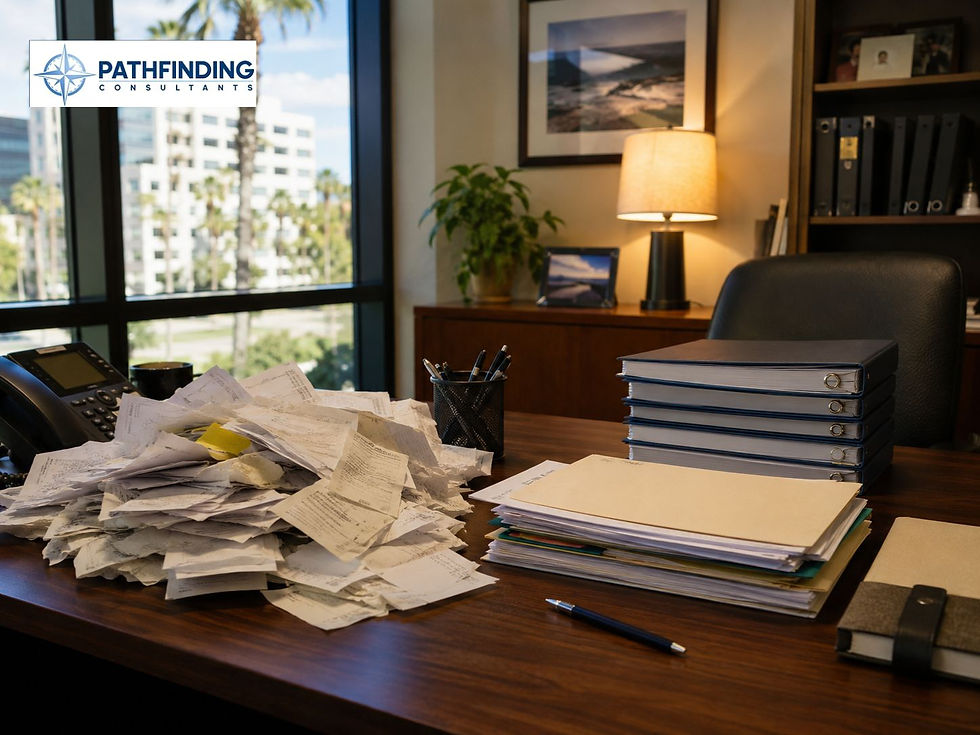
The IRS requires businesses to keep records that support the items reported on a business tax return. According to IRS Publication 583, supporting documents include sales slips, paid bills, invoices, receipts, deposit slips, and canceled checks. These records substantiate the income and the tax deductions small business owners report. Bookkeeping for taxes is the process of maintaining these records in an organized form throughout the year. Source: IRS Publication 583.
Records must be kept until the period of limitations expires IRS Publication 583 states that records must be kept as long as they may be needed for the administration of any provision of the Internal Revenue Code — generally until the period of limitations for that return expires. For most business returns, the IRS generally advises keeping records that support income and deductions until the period of limitations runs out. Bookkeeping for taxes maintains these records in order so they are available if the IRS requests them. Source: IRS Publication 583. |
Source: IRS Publication 583, Starting a Business and Keeping Records — irs.gov/publications/p583. |
How Bookkeeping Affects Tax Deductions

A business expense is deductible only if it is ordinary and necessary for the business (IRC §162) and is supported by adequate records. The IRS places the burden of proving a deduction on the taxpayer. This is the direct way how bookkeeping affects taxes: a deduction must be substantiated by records. When records are not maintained, the documentation required to support a deduction may not be available. Bookkeeping for taxes is the function that captures and organizes this documentation. Source: IRC §162; IRS Publication 583.
Certain expenses have specific substantiation requirements Under IRC §274(d), travel, meals, gift, and vehicle expenses require specific documentary substantiation — generally the amount, time, place, and business purpose of the expense. IRS Publication 463 sets out these requirements in detail. Tax deductions small business owners claim in these categories must meet the §274(d) substantiation standard. Maintaining these records through bookkeeping for taxes is how the documentation is preserved. Source: IRC §274(d); IRS Publication 463. |
Business and personal funds should be kept separate IRS Publication 583 recommends keeping business and personal funds separate, including using a separate business checking account. Separating accounts supports accurate recordkeeping and helps substantiate which expenses are business expenses. This is a documented IRS recordkeeping recommendation. Source: IRS Publication 583. |
IRS Recordkeeping Requirements — By Source
The following requirements are stated directly in IRS publications and the Internal Revenue Code. Each is the basis for how bookkeeping affects taxes:
IRS Recordkeeping Requirement | IRS Source |
Every taxpayer must keep records sufficient to establish income and deductions reported on a return. | IRC §6001; IRS Publication 583 |
A business expense must be ordinary and necessary to be deductible. | IRC §162 |
The burden of proving a deduction is on the taxpayer; supporting records must be retained. | IRS Publication 583 |
Travel, meals, gift, and vehicle expenses have specific documentary substantiation requirements. | IRC §274(d); IRS Publication 463 |
Records must support items reported until the period of limitations for that return expires. | IRS Publication 583 |
Sources as cited. IRC = Internal Revenue Code. IRS publications available at irs.gov. |
Questions about your business records and deductions?
Pathfinding Consultants provides bookkeeping services Orange County businesses use alongside business tax preparation. Book a consultation now.
Call: (949) 620-1036 · pathfindingconsultants.com
What Records the IRS Identifies for Small Businesses

IRS Publication 583 identifies the categories of records a small business should keep. These records are the foundation of bookkeeping for taxes and support the business tax return:
|
Bookkeeping and Tax Preparation at Pathfinding Consultants

Pathfinding Consultants provides both bookkeeping and business tax preparation for Orange County small businesses. When owners search for tax firms near me, bookkeeping services near me, or an enrolled agent near me, Pathfinding Consultants provides:
|
Coordinate your bookkeeping and tax preparation
Pathfinding Consultants provides bookkeeping services Orange County businesses use alongside business tax preparation.
Call: (949) 620-1036 · pathfindingconsultants.com
Key Takeaways
|
IRS DISCLAIMER: This blog is for general informational purposes only and does not constitute tax advice. Tax laws are complex and subject to change. Every business situation is different. Please consult a qualified tax professional before making any tax decisions. For official IRS guidance visit irs.gov. |


Comments