


States Without Business Income Tax — and the Gross Receipts Taxes That Replace It


"No corporate income tax" is one of the most persuasive phrases in business relocation marketing, and one of the least complete. Six states levy no corporate income tax — and four of them replace it with a tax on revenue rather than profit, which for a thin-margin Orange County business can cost more than the income tax it avoided. Pathfinding Consultants provides business tax preparation Orange County business owners rely on to compare the whole burden rather than one headline rate.
IRS DISCLAIMER: This article is for general informational purposes only and is not tax, legal, or accounting advice. State tax rates, thresholds, and exemptions change frequently and vary by industry and entity type. Always consult a qualified tax professional, Enrolled Agent, or CPA and confirm current state figures before relying on this guide for a specific decision. Pathfinding Consultants encourages every Orange County business owner to seek personalized guidance for their own business. |
Which States Actually Have No Corporate Income Tax
Forty-four states levy a corporate income tax, with top rates ranging from a 2 percent flat rate in North Carolina to an 11.5 percent top marginal rate in New Jersey. The average top marginal rate among states that impose one is approximately 6.57 percent, and the median is 6.5 percent (source: Tax Foundation, State Corporate Income Tax Rates and Brackets, 2026).
Six states impose no corporate income tax: Nevada, Ohio, South Dakota, Texas, Washington, and Wyoming. That is the complete list of states without business income tax at the corporate level. For comparison, California's corporate rate sits at 8.84 percent — above the national median and the figure that drives most of the relocation conversations an Orange County business owner hears.
Four of the Six Replace It with a Gross Receipts Tax
Nevada, Ohio, Texas, and Washington do not have a corporate income tax but do have a gross receipts tax, with rates not strictly comparable to corporate income tax rates (source: Tax Foundation, 2026). Only South Dakota and Wyoming impose neither a corporate income tax nor a gross receipts tax (source: Tax Foundation, State Corporate Income Tax Rates and Brackets, 2026).
The distinction matters more than the label. A gross receipts tax applies to total revenue regardless of whether the business is profitable, while a corporate income tax is based on net income after deducting expenses. Because a gross receipts tax is levied on revenue rather than profit, businesses with thin margins can face higher effective rates under a gross receipts regime than they would under an income-based system. A high-revenue, low-margin operation can pay more in a "no income tax" state than it would have paid in a state with a conventional corporate tax.

What Each of the Four Actually Charges
Texas imposes a franchise tax, commonly called the margin tax, at 0.75 percent of taxable margin, with a reduced 0.375 percent rate for qualifying retailers and wholesalers. Revenue below a no-tax-due threshold is generally exempt; that threshold is periodically adjusted, so the current figure should be confirmed rather than assumed.
Washington levies a business and occupation tax on gross receipts, with the rate varying by business classification and no deduction allowed for cost of goods sold or payroll. Ohio replaced its corporate income tax with the Commercial Activity Tax, a gross receipts tax at 0.26 percent above an annual exclusion amount that the state has raised in recent years. Nevada imposes a commerce tax on gross receipts above $4 million, at industry-specific rates. The common thread across all four is that no deduction for expenses reaches the base.

Evaluating a state for expansion or relocation?
Pathfinding Consultants — Business Tax Preparation, Orange County, CA
(949) 620-1036 | pathfindingconsultants.com
Some States Charge Both
A gross receipts tax is not always a substitute for the corporate income tax. Delaware, Oregon, and Tennessee impose gross receipts taxes in addition to their corporate income taxes (source: Tax Foundation, 2026). A business evaluating those states is looking at two entity-level taxes rather than one.
That combination is easy to miss because the gross receipts tax often carries a different name — a commercial activity tax, a business privilege tax, an excise tax — and does not appear in a corporate income tax rate comparison at all. Any state survey built only from corporate rate tables will understate the burden in states that layer a receipts tax on top, which is why states without business income tax and states with a low overall business tax burden are not the same list.

Pass-through Owners Are Measuring the Wrong Tax
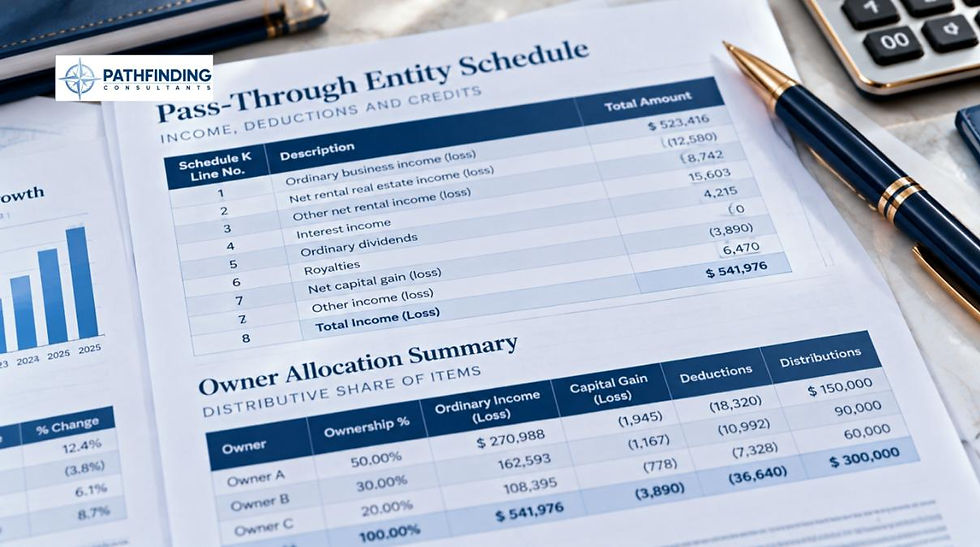
Most Orange County small businesses are LLCs and S corporations, and a corporate income tax rate comparison is largely beside the point for them. A pass-through entity generally does not pay corporate income tax at all — income flows to the owners and is taxed on their individual returns at their own rates.
For a pass-through owner the relevant comparison is the personal income tax rate in the destination state, plus whatever entity-level taxes apply regardless of classification. Gross receipts taxes typically do apply to pass-through entities, which is precisely why a Washington B&O tax or a Texas margin tax reaches an LLC that would have owed no corporate income tax anywhere. Comparing corporate rates while operating as an S corporation compares a tax the business was never going to pay.
Rates Move, and They Moved This Year
State corporate rates are not static. Several states reduced their corporate income tax rates effective January 1, 2026, and no states increased them (source: Tax Foundation, State Corporate Income Tax Rates and Brackets, 2026). North Carolina's 2 percent flat rate is itself part of a scheduled phase-down. A comparison built on a table from two years ago is comparing rates that no longer exist.
For an Orange County business weighing a multi-year decision, the practical implication is that the analysis needs a refresh date rather than a conclusion. Gross receipts thresholds in particular move — Ohio has raised its Commercial Activity Tax exclusion in recent years, and the Texas no-tax-due threshold is adjusted periodically — which can move a business in or out of a filing obligation without any change in its own revenue.

Why the Comparison Has to Be Run on Your Own Numbers
Business consulting near me searches from Orange County owners spike after a relocation or expansion decision is already committed and the first gross receipts filing arrives. Pathfinding Consultants is an Enrolled Agent firm providing business tax preparation Orange County business owners have relied on to model the actual burden — corporate or pass-through, gross receipts, franchise, and apportionment — against the business's own revenue and margin profile rather than against a headline rate.
Owners evaluating multistate exposure should also see our guide to California income tax nexus and Public Law 86-272, since operating in a new state creates obligations regardless of where the entity is formed, and our bookkeeping services overview for the revenue-by-state detail the analysis requires. A business consulting near me conversation before the lease is signed is when the numbers still change the decision.

Common Mistakes Comparing State Business Taxes
Treating "no corporate income tax" as no entity-level tax, when four of the six such states impose a gross receipts tax instead
Comparing corporate income tax rates while operating as a pass-through entity that would never have paid that tax
Overlooking Delaware, Oregon, and Tennessee, which impose gross receipts taxes on top of a corporate income tax
Assuming a gross receipts tax is mild because the rate is a fraction of a percent, without applying it to revenue at the business's actual margin
Relying on a rate table from a prior year, when several states adjusted corporate rates and receipts thresholds effective in 2026
Every one of these mistakes is avoidable when the comparison is run on the business's own revenue and margin, includes every entity-level tax rather than the corporate income tax alone, and is refreshed against current-year figures before a decision is made. A business consulting near me search early in the evaluation is when business tax preparation Orange County support can model the real burden, because the list of states without business income tax is not the same as the list of low-tax states.

Get a state comparison run on your actual revenue and margin.
Pathfinding Consultants — Business Tax Preparation, Orange County, CA
(949) 620-1036 | pathfindingconsultants.com


Comments