


Dropshipping Sales Tax: Three-Party Transactions, Resale Certificates, and Marketplace Rules


One box leaves one warehouse and arrives at one customer. For sales tax purposes, that single delivery is two separate transactions with two different taxable events, and an Orange County e-commerce seller can end up paying tax on the wholesale leg after already collecting it on the retail leg. Dropshipping sales tax is among the most audit-prone structures in e-commerce. Pathfinding Consultants provides business tax preparation Orange County online sellers rely on to get both legs of the transaction right.
IRS DISCLAIMER: This article is for general informational purposes only and is not tax, legal, or accounting advice. Sales tax obligations vary substantially by state and depend on your own activities, your supplier's activities, and current state agency guidance. Always consult a qualified tax professional, Enrolled Agent, or CPA before relying on this guide for a specific registration or filing decision. Pathfinding Consultants encourages every Orange County business owner to seek personalized guidance for their own business. |
One Shipment, Two Transactions
In a drop shipment the retailer takes the order and payment from the end customer, the supplier holds the inventory, and the customer receives the goods directly from the supplier. For sales tax purposes that arrangement is treated as a three party transaction producing two separate sales (source: state sales tax drop shipment guidance; CDTFA).
The first sale runs from supplier to retailer and is a wholesale sale for resale, which should be exempt from sales tax. The second runs from retailer to end customer and is a retail sale, taxable in the delivery state where the retailer has nexus. Dropshipping sales tax problems almost always come from treating the shipment as one event, because the exemption on the first leg and the collection duty on the second leg are governed by entirely different rules.
The Retail Leg and Your Own Nexus
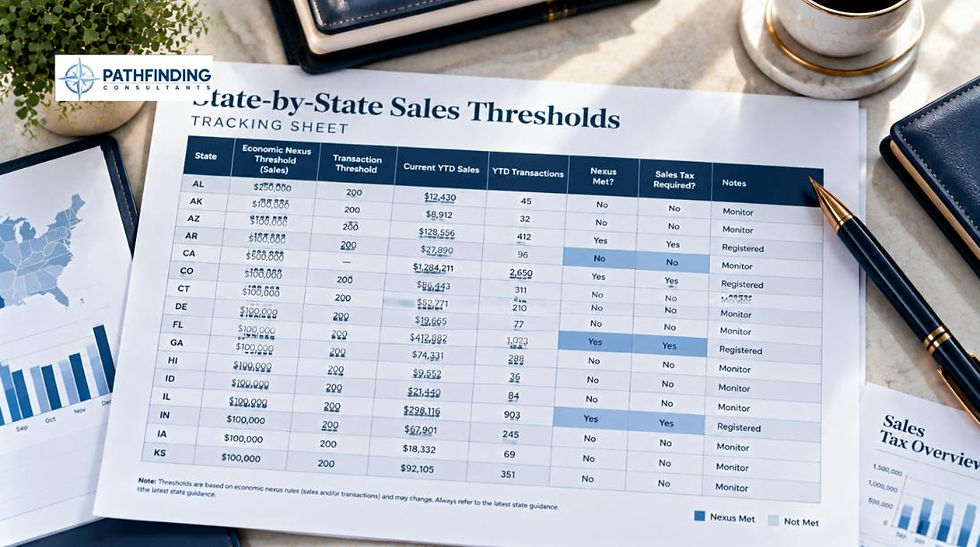
On the retail leg, the seller collects tax from the final customer based on the delivery state, but only where the seller has nexus in that state. Nexus is measured by the seller's own activities, not the supplier's. Economic thresholds vary: California requires a remote retailer to register and collect once total combined sales of tangible personal property for delivery into the state exceed $500,000 in the preceding or current calendar year, using a sales-only test with no transaction count, while other states apply both a dollar figure and a transaction count (source: CDTFA, Use Tax Collection Requirements Based on Sales into California Due to the Wayfair Decision).
That variation is why a three party transaction requires state-by-state tracking rather than a single rule. A seller can be over the threshold in one destination state and under it in the next, with a collection duty in the first and none in the second, on identical products shipped the same week. New York, for example, applies both a dollar threshold and a transaction count and requires a remote seller to register within a set window after crossing it.
The Wholesale Leg and the Resale Certificate
The supplier's position is the mirror image. A supplier with nexus in the delivery state will charge the retailer sales tax on the wholesale invoice unless the retailer provides a valid resale certificate (source: CDTFA, Sales for Resale). The resale certificate is what makes the wholesale leg exempt, and it is the supplier's audit protection — not the marketplace's collection, and not the retailer's assurance that tax was handled downstream.
Resale certificate acceptance is where the rules fracture by state. Some states accept a certificate issued by the retailer's home state; others require a certificate issued by that state specifically, which in practice means the retailer must be registered there. A small group of states will charge the supplier sales tax on every wholesale invoice unless the retailer holds a local permit. Failing to keep resale certificates on file produces the worst outcome in the structure: the supplier charges tax on the wholesale purchase after the retailer has already collected tax from the customer, and the margin absorbs both.

Selling online with supplier-fulfilled shipments?
Pathfinding Consultants — Business Tax Preparation, Orange County, CA
(949) 620-1036 | pathfindingconsultants.com
Marketplace Facilitator Laws Sit on Top
Every state with a sales tax now has a marketplace facilitator law (source: state marketplace facilitator statutes; South Dakota v. Wayfair, 585 U.S. 162 (2018)). These laws generally require platforms such as Amazon, eBay, and Walmart Marketplace to collect and remit sales tax on sales made through the platform, regardless of who actually fulfills the order. Where a drop-shipped product sells through a marketplace, the facilitator typically assumes the collection obligation on that retail leg.
The marketplace facilitator rules do not reach the wholesale leg at all. The platform's collection handles the sale from the seller to the end customer; it does not touch the sale from the supplier to the seller. That wholesale transaction remains separate, and without a valid resale certificate the supplier will still charge tax on it — regardless of whether the final customer already paid tax through the marketplace. Most states also still require a registered seller to report marketplace sales on its own returns, typically as a deduction from gross sales rather than as an omission.

The Hybrid Seller Has the Hardest Compliance Profile
The most difficult case is the seller running two channels at once — a marketplace storefront alongside a direct site. Each leg is analyzed separately. On the marketplace retail leg, the facilitator collects. On the direct-site retail leg, the seller collects wherever it has nexus. Inventory the seller owns and stores in a fulfillment center is not a drop shipment at all; it is the seller's own inventory, and its physical location can itself create nexus.
For the drop-shipped portion of the direct site, the wholesale leg still needs a resale certificate delivered to the supplier. A three party transaction running through one channel and a two party transaction running through another produce different documentation requirements from the same week of sales, which is why the reconciliation has to be built by channel rather than in aggregate.

What an Audit Actually Looks at
A sales tax examination of a drop shipping operation reviews the transaction chain, the validity of resale certificates on file, and whether each state accepted the certificate form used. Where a certificate is rejected, back tax attaches to the wholesale leg — for periods that can reach back indefinitely where returns were never filed in that state.
The defensive posture is documentary. Documenting the drop ship chain, reviewing resale certificates against each state's acceptance rules, and assessing nexus and registration state by state is what converts an audit from an assessment into a reconciliation. Business consulting near me searches from Orange County sellers spike after a supplier begins charging tax on wholesale invoices with no explanation, which is usually the first visible symptom of a certificate problem.

Why the Certificate File Is the Whole Defense
Pathfinding Consultants is an Enrolled Agent firm providing business tax preparation Orange County online sellers have relied on to maintain a current resale certificate for every supplier in every state that requires one, and to track sales by destination state against each threshold on a rolling basis rather than annually.
Sellers reviewing multistate exposure should also see our guide to sales tax economic nexus after Wayfair, and our bookkeeping services overview for the by-state revenue tracking the analysis depends on. A business consulting near me conversation during a growth year is when registration can still be handled prospectively rather than backdated with historical tax.

Common Mistakes with Dropshipping Sales Tax
Treating the shipment as one transaction rather than a wholesale leg and a retail leg with separate rules
Failing to provide and retain a valid resale certificate for each supplier, producing tax on the wholesale invoice
Assuming a home-state resale certificate is accepted everywhere, when some states require an in-state certificate
Believing marketplace facilitator collection covers the wholesale leg, which it does not
Omitting marketplace sales from the seller's own returns, when most states require them reported as a deduction from gross sales
Every one of these mistakes is avoidable when resale certificates are collected before the first wholesale purchase in a state, nexus is tracked by destination state on a rolling basis, and each sales channel is reconciled separately rather than in aggregate. A business consulting near me search before expanding into a new state is when business tax preparation Orange County support can set up the certificate file prospectively.

Get your drop shipping sales tax chain documented before an audit reviews it.
Pathfinding Consultants — Business Tax Preparation, Orange County, CA
(949) 620-1036 | pathfindingconsultants.com


Comments